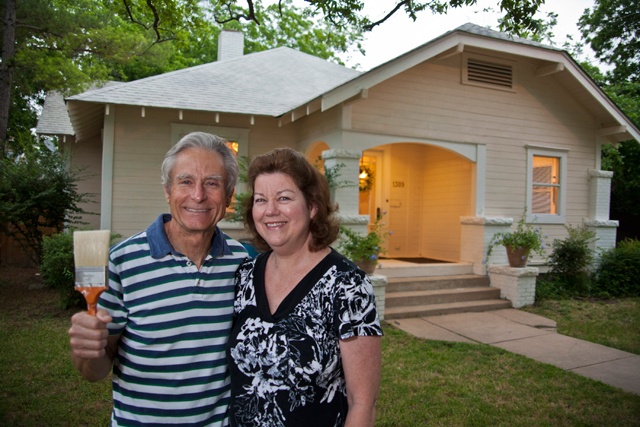
My parents’ home in historic Georgetown may be old, but in a way, the Craftsman-style bungalow is ahead of its time. Anchoring a corner of a Central Texas neighborhood, the 1924 house is clad in traditional colors and sports a snowy white roof. That’s right—a white roof.
Two years ago, my dad, Gary Halko, a practicing dentist, increased the comfort of his indoor air by cooling down his roof. He applied a white coating with tiny ceramic beads to serve as a radiant barrier, blocking heat from the sun before penetrating the house.
“I compare it to a lizard’s skin,” he said, thinking back on his undergraduate zoology studies. “Lizards, especially sand-dwelling lizards, have their light-colored skin, and that skin is able to keep them from absorbing amounts of sun that would be dangerous to them.”
The virtues of cool roofs—keeping interiors cool, reducing electricity demand and preventing heat absorption in urban areas—are getting noticed nationwide. But so far, products have been applied and tested mostly on commercial and new roofs.
Dad explored somewhat new frontier with his residential project. On a 100-degree day one August, he measured the temperature over his 12-year-old, gray asphalt roof shingles. It hit 150 degrees. “You could not put a bare hand or foot on it without hurting,” he said.
With the extreme heat on the outside, the temperature in his attic registered around 120 degrees. Inside, the ceiling heated up, radiated heat and made his air conditioner struggle.
So Dad researched cool roofs, and after checking with city code officials and neighbors, he bought 55 gallons of adhesive and paint-on coating for his 3,000-square-foot roof. With the help of my mom, Carol, he spent two days cleaning, prepping and applying two coatings with an airless paint sprayer.
When he was done, Dad took the temperature over his white shingles. This time, the temperature was 115 degrees. Inside, his attic’s temperature never surpassed 100; his air conditioner came on later and cycled less.
While aftermarket roof coatings are newer products with unobserved long-term results, said Jessica Clark, marketing liaison for the Cool Roof Rating Council, Dad believes he’s added another 10 years to his roof’s life. He said he will prolong the coating’s reflectivity by keeping it clean and applying touch-ups.
To celebrate his cool roof, Dad took off his shoes and took a picture of his bare feet while standing on the bright white shingles.
——————–
Suzanne Haberman, staff writer
Editor’s note: Before tackling your own cool roof project, be sure to check the area’s building codes, learn about your roof’s warranty and research product options.